
Understanding Scale Conversion for Model Builders
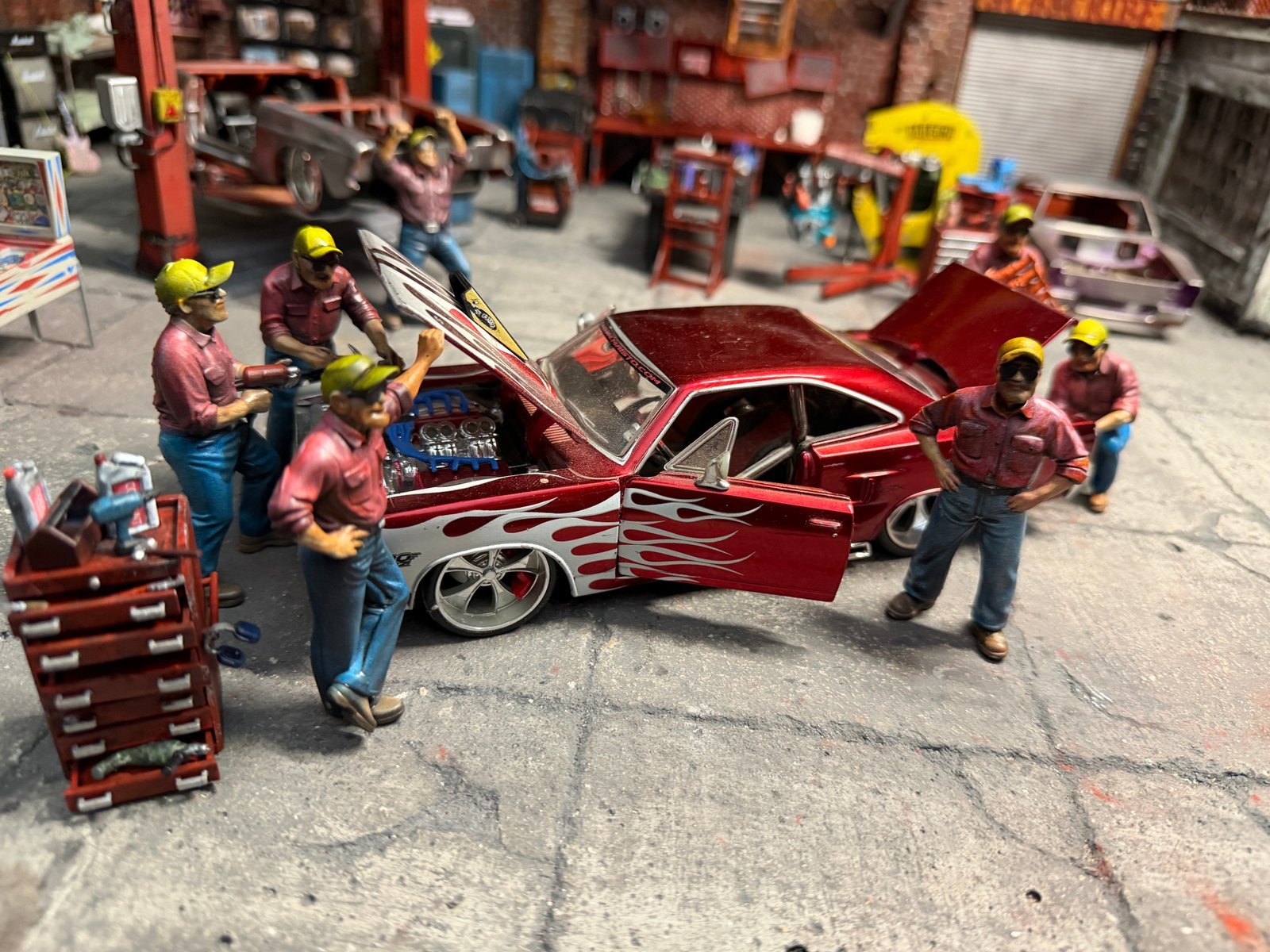
Scale is the single most important concept in miniature and diorama building, yet it trips up newcomers constantly. A scale ratio such as 1:24 simply means that one unit on the model represents twenty-four of the same units in the real world. A real hot rod that measures 4.5 metres from bumper to bumper becomes roughly 187.5 millimetres long in 1:24 — small enough to sit in the palm of your hand, but faithful to every proportion of the original vehicle. Getting these conversions right is what separates a believable build from one that looks "off" without the viewer quite knowing why.
Why 1:24 dominates the hobby
The 1:24 scale is the workhorse of automotive modeling. It is large enough to reward detailing — visible engine bays, opening doors, wiring, and weathering — while still being compact enough to display a whole collection on a single shelf. Sister scales such as 1:18 (larger, die-cast favourite) and 1:35 (the standard for military armour and figures) each have their own communities. This converter lets you translate a single real-world measurement across all of them at once, so you can mix a 1:24 car into a 1:35 apocalyptic scene and know exactly how far off the proportions will be.
How to measure your reference object
Always work from the largest reliable dimension you can find. For vehicles, the wheelbase and overall length are the most trustworthy figures because manufacturers publish them precisely. For buildings and diorama props, standard architectural dimensions — a 2.1 metre door, a 215 millimetre house brick, a 1.5 metre fence — give you anchors that instantly make a scene read as "real". Enter that measurement above, pick your unit, and the table returns the scaled equivalent in millimetres, centimetres and inches simultaneously.
Common conversion mistakes
The two errors we see most often are mixing units mid-project and rounding too aggressively. If you measure one part in inches and another in centimetres without converting, your parts will never line up. And because scale division amplifies small errors, always keep at least two decimal places when cutting styrene or planning a 3D print. Treat the millimetre column as your source of truth on the bench — most hobby rulers and callipers are marked in millimetres, and it is the unit least prone to rounding drift.
Bookmark this converter and pair it with the Tire & Stance calculator and the Brick Generator to plan an entire scene before you cut a single piece of plastic. Precise measurement up front saves hours of filler, sanding and frustration later.